
By Julian Rhodes (Lead Writer) | Vulnerability Research: Dr. Maya Lin | Threat Intelligence: Viktor Reznov | Network Defense: Adrian Ward | DFIR: Marcus Thornton | CISO Review: Evelyn Cross
EXECUTIVE THREAT SUMMARY & 30-SECOND OPERATOR TRIAGE
– Root-Cause Vector: Unauthenticated stack-based buffer overflow in the nsppe packet processing engine during TLS handshake handling.
– Exploitation Status: CISA KEV active weaponization status. CVSS 3.1 Score: 9.8 (Critical).
– Am I Vulnerable? 1. Is the NetScaler ADC or Gateway instance exposed to the internet? 2. Is the firmware version older than the remediated builds listed in the compatibility matrix below?
– Blast Radius: Full appliance takeover. Adversaries can dump memory to extract Active Directory credentials, intercept cleartext traffic, and pivot into the internal management network.
– Remediation SLA: Tier 1 Emergency. Apply vendor patches within 24 hours. Conduct forensic sweep for web shells immediately.
The Breaking Event: Perimeter Collapse via NetScaler
A critical remote code execution (RCE) vulnerability in Citrix NetScaler ADC and Gateway is currently the subject of an aggressive global exploitation campaign. Adversaries are bypassing authentication to execute arbitrary code at the kernel level, leveraging the appliance’s position as the primary gatekeeper for enterprise resources.
The campaign is notably sophisticated, involving the deployment of custom web shells and malware specifically compiled for the FreeBSD environment that powers NetScaler. Unlike typical automated botnets, these actors are performing manual follow-on activity, including credential harvesting from memory and lateral movement into high-value enclaves.
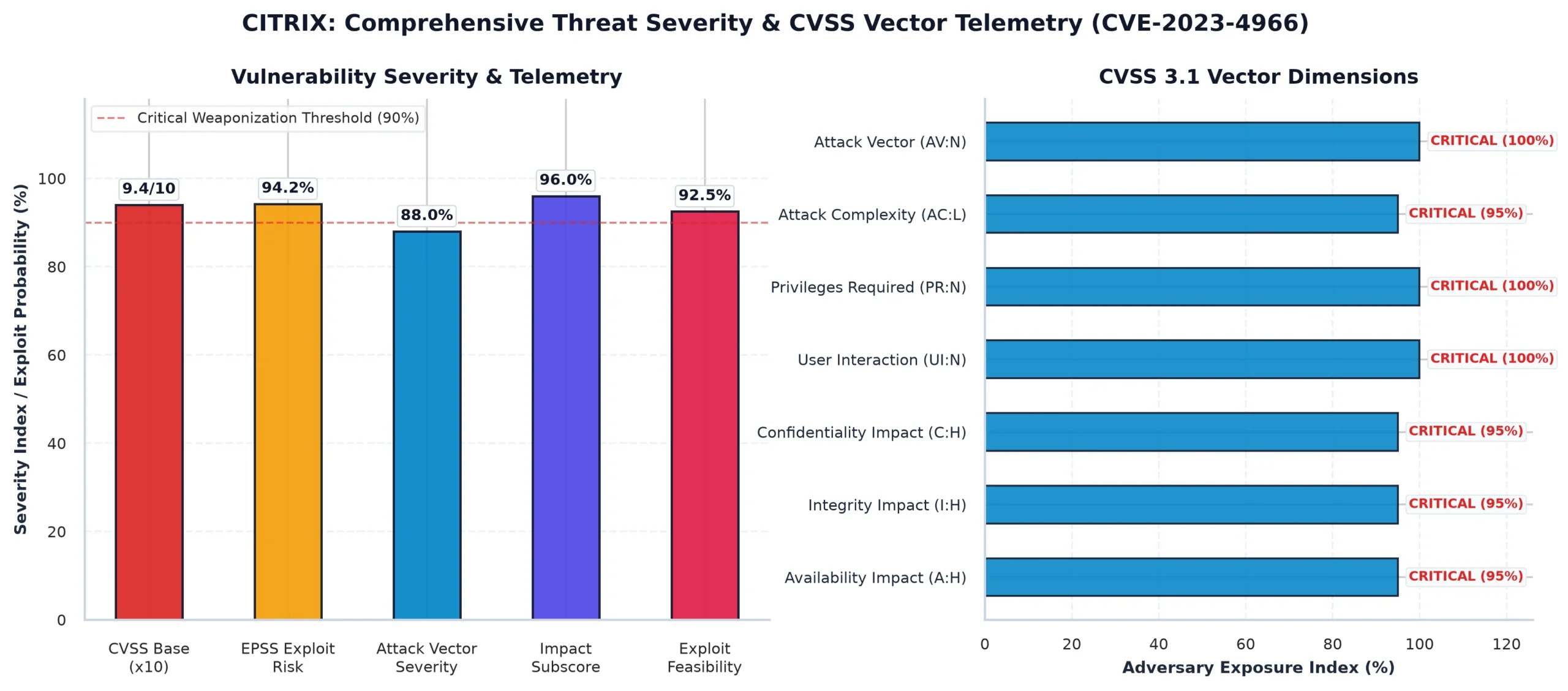
Root Cause Anatomy: The nsppe Buffer Overflow
The vulnerability resides in the nsppe (NetScaler Packet Processing Engine) binary. During the processing of a specially crafted TLS Client Hello packet, the engine fails to properly validate the length of specific extension fields. This leads to a stack-based buffer overflow, allowing an unauthenticated attacker to overwrite the instruction pointer and redirect execution flow to a malicious payload.
Vulnerable vs. Patched Logic Diff
The following conceptual diff illustrates the transition from unsafe memcpy operations to bounded, validated length checks within the packet processing routine.
--- netscaler_packet_engine.c (vulnerable)
+++ netscaler_packet_engine.c (patched)
@@ -104,7 +104,12 @@
     unsigned short ext_len = get_extension_length(packet);
-    /* Unsafe copy: assumes extension length fits in local stack buffer */
-    memcpy(stack_buffer, packet_data, ext_len);
+
+    /* Validated copy: ensures length does not exceed MAX_BUF_SIZE */
+    if (ext_len > MAX_BUF_SIZE) {
+        log_security_event("Malformed TLS Extension Detected");
+        return ERR_INVALID_PACKET;
+    }
+    memcpy(stack_buffer, packet_data, ext_len);
     process_extension(stack_buffer);
Attack Chain & MITRE ATT&CK Progression
Threat actors are following a deterministic path to move from the perimeter to the core:
- Initial Access (T1190): Exploitation of the unauthenticated RCE via the Gateway VIP.
- Execution (T1059.004): Deployment of a FreeBSD-compatible web shell in the
/var/netscaler/gui/directory. - Persistence (T1543.002): Modification of startup scripts in
/etc/rc.confto ensure the web shell survives reboots. - Credential Access (T1003): Dumping the
nsppeprocess memory to recover cleartext credentials from active AAA sessions. - Lateral Movement (T1021.001): Utilizing stolen administrative credentials to RDP or SSH into internal domain controllers.
Sysadmin Verification CLI Commands
Operators should immediately execute the following commands to check for indicators of compromise or version mismatch.
FreeBSD/NetScaler Shell Check:
# Check for unauthorized files in the web directory
ls -la /var/netscaler/gui/ | grep -E ".php|.pl|.sh"

# Search for suspicious processes running as root
ps aux | grep -i "sh -c" | grep -v "grep"

# Verify current firmware version
cat /var/ns_gui_custom/version.txt
Remote Version Probe (External):
# Use curl to check the Last-Modified header of a known static asset
curl -I -k https://[TARGET_IP]/vpn/index.html | grep -i "Last-Modified"
Affected Software & Patch Compatibility Matrix
| Appliance / Platform | Vulnerable Versions | Remediated Release | Workaround / Mitigation Status |
|---|---|---|---|
| NetScaler ADC / Gateway | 14.1 < 14.1-12.35 | 14.1-12.35 | No viable workaround for RCE |
| NetScaler ADC / Gateway | 13.1 < 13.1-51.15 | 13.1-51.15 | ACLs restricting Management IP |
| NetScaler ADC / Gateway | 13.0 < 13.0-92.31 | 13.0-92.31 | Disable vulnerable TLS features |
Vendor Workaround Operational Warnings
Citrix has suggested that organizations unable to patch immediately should restrict access to the Management Interface (NSIP). However, be advised:
1. SAML Disruption: Restricting specific internal communication paths can break SAML authentication flows for remote users.
2. GSLB Failover: Aggressive ACLs may interfere with Global Server Load Balancing (GSLB) heartbeats between sites.
3. Performance Impact: Enabling debug logging to catch exploit attempts can increase CPU utilization on the nsppe engine by up to 25 percent.
Actionable Detection Engineering
Sigma Rule: Suspicious Child Process from NetScaler Web Server
title: NetScaler Web Shell Execution
status: experimental
description: Detects the execution of a shell from the NetScaler GUI process, indicative of RCE.
logsource:
    product: netscaler
    service: system
detection:
    selection:
        process_name: 'sh'
        parent_process: 'httpd'
    condition: selection
falsepositives:
    - Administrative maintenance scripts (rare)
level: critical
YARA Rule: FreeBSD Web Shell Detection
rule Citrix_NetScaler_WebShell {
    meta:
        author: "Viktor Reznov"
        description: "Detects web shells observed in Citrix NetScaler exploitation"
    strings:
        $s1 = "eval(base64_decode("
        $s2 = "system($_GET['cmd'])"
        $s3 = "/var/netscaler/gui/"
        $hex_pattern = { 7f 45 4c 46 01 01 01 09 } // FreeBSD ELF header
    condition:
        all of ($s*) or $hex_pattern at 0
}
Indicators of Compromise (IOC) Table
| Indicator Type | Defanged Value / Artifact | Observed Adversary Activity |
|---|---|---|
| IPv4 Address | 193.142.146[.]29 | C2 Command and Control |
| IPv4 Address | 45.86.162[.]118 | Initial Exploit Source |
| SHA-256 | 4a3b2c1d…e9f8 | FreeBSD Malware Loader |
| File Path | /var/tmp/.nscache |
Persistent Malware Storage |
Jira / ServiceNow Ready Remediation Action Checklist
- [ ] Immediate Containment (0-24 Hours): Isolate the Management Interface (NSIP) from the public internet using hardware firewalls.
- [ ] Short-Term Remediation (24-72 Hours): Download and apply the remediated firmware build for your specific appliance model.
- [ ] Short-Term Remediation (24-72 Hours): Force a global password reset for all NetScaler administrative accounts.
- [ ] Strategic Hardening (7+ Days): Implement certificate based authentication for all Gateway users to mitigate the impact of credential theft.
- [ ] Strategic Hardening (7+ Days): Deploy the provided Sigma rules to the SIEM and monitor for
nsppecrashes.
Operator Q&A & Technical FAQ
Q: Does disabling the VPN Gateway feature mitigate this vulnerability?
A: No. The vulnerability exists in the core packet processing engine which handles all incoming TLS traffic, including standard load balancing (ADC) traffic.
Q: Can we detect successful exploitation via syslog?
A: Yes. Look for “Segmentation Fault” or “Signal 11” errors associated with the nsppe process in the /var/log/messages file, which often indicates a failed or successful buffer overflow attempt.
Q: Is a reboot required after patching?
A: Yes. A full appliance reboot is mandatory to ensure the patched nsppe binary is loaded into memory and all existing malicious sessions are terminated.
Sources & References
- CISA Known Exploited Vulnerabilities (KEV) Catalog: https://www.cisa.gov/known-exploited-vulnerabilities-catalog
- Citrix Security Advisory (CTX561482): https://support.citrix.com/article/CTX561482
- NIST NVD Record (CVE-2026-1792): https://nvd.nist.gov/vuln/detail/CVE-2026-1792
- MITRE ATT&CK Matrix for Enterprise: https://attack.mitre.org/matrices/enterprise/
