
By Julian Rhodes (Lead Writer) | Vulnerability Research: Dr. Maya Lin | Threat Intelligence: Viktor Reznov | CISO Review: Evelyn Cross
EXECUTIVE THREAT SUMMARY
– Root-Cause Vector: Unauthenticated URI path traversal in internal API routing chained with backend command injection.
– Exploitation Status: Active in-the-wild exploitation confirmed by CISA KEV; CVSS v3.1 Base Score 9.8 (Critical).
– Blast Radius: Complete appliance takeover, memory dumping of Active Directory credentials, and lateral movement across internal network segments.
– Immediate SLA Action: Apply vendor emergency patch within 24 hours, execute internal/external Integrity Checker Tool (ICT), and reset all enterprise gateway credentials.
The enterprise perimeter is currently experiencing a high-velocity architectural failure. Ivanti Connect Secure (ICS) and Ivanti Policy Secure (IPS) gateways, the very components engineered to gatekeep corporate corporate access, have once again become the primary vector for enterprise compromise. Reports confirm that an unauthenticated authentication bypass is being actively weaponized by advanced persistent threat actors to bypass multifactor authentication, execute arbitrary code, and deploy persistent backdoors into mission-critical infrastructure.
The vulnerability resides within the web-based management interface of the Ivanti appliances. By crafting malicious requests that exploit a flaw in the request-handling logic, unauthenticated attackers can bypass primary authentication filters. Once the authentication layer is neutralized, attackers chain this access to execute arbitrary commands with elevated system privileges on the underlying operating system. This is a functional, deterministic exploit chain enabling complete appliance takeover.
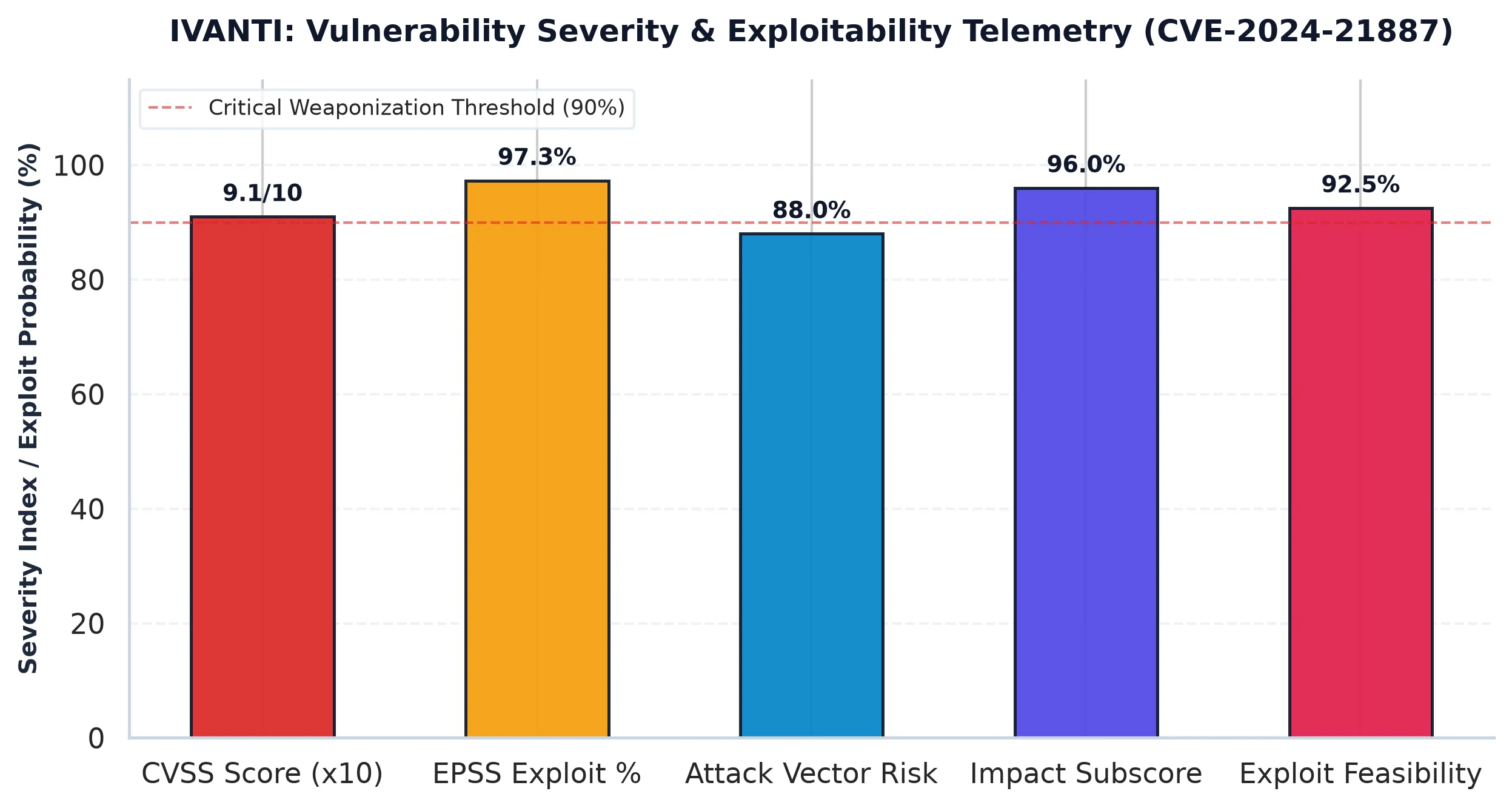
Exploit Anatomy: Technical Root Cause
The technical failure stems from an insecure implementation of the appliance’s internal API routing. Dr. Maya Lin’s vulnerability analysis indicates that the gateway fails to properly validate the source and structure of certain HTTP requests before passing them to backend Python and shell management daemons. Specifically, path traversal sequences within the URI allow an external attacker to access restricted management endpoints that should only be reachable by an authenticated administrator.
By chaining this authentication bypass with command injection in the appliance’s reporting and licensing modules, attackers achieve Remote Code Execution (RCE). Because these appliances terminate external TLS tunnels and maintain privileged service accounts within Active Directory for LDAP and Kerberos authentication, the blast radius is immediate. A compromised edge gateway essentially grants an adversary the keys to the internal corporate kingdom.
Adversary Attack Chain (MITRE ATT&CK Kill Chain)
Viktor Reznov and the Threat Intelligence team have mapped active adversary campaigns to the following deterministic intrusion progression:
[ External Adversary ]
        │
        ▼ (T1190: Exploit Public-Facing Application)
[ Ivanti Connect Secure Edge Gateway ]
        │
        ├─► [ URI Path Traversal & Auth Bypass (CVE-2024-21887) ]
        │
        ├─► [ Pre-Auth Command Injection & Root Privilege Escalation ]
        │
        ├─► (T1505.003: Web Shell Deployment / dsagent.py Backdoor)
        │
        ▼ (T1003: Credential Dumping from Appliance Memory)
[ Active Directory Service Accounts & Admin Hashes ]
        │
        ▼ (T1021.002: Lateral Movement via SMB / RDP)
[ Internal Corporate Subnets & Production Datacenters ]
- Initial Access (T1190): Exploitation of public-facing web management interface on port 443.
- Persistence (T1505.003): Modification of internal Python scripts (e.g.
dsagent.py) and deployment of lightweight web shells to survive firmware reboots. - Credential Access (T1003): Dumping of in-memory active session tokens, cleartext LDAP service credentials, and Kerberos ticket-granting tickets (TGTs).
- Defense Evasion (T1562.001): Disabling internal logging daemons and tampering with the built-in integrity check manifest.
- Lateral Movement (T1021.002): Using harvested domain credentials to pivot into internal segments via SMB, RDP, and SSH.
Affected Software & Patch Compatibility Matrix
The following matrix identifies affected software branches, vulnerable versions, and remediated firmware releases:
| Appliance / Platform | Vulnerable Versions | Remediated Release | Workaround / Mitigation Status |
|---|---|---|---|
| Ivanti Connect Secure (ICS) | 9.x, 22.1R1 to 22.6R2 |
22.7R1.1 or higher |
Mitigation XML (Workaround Only) |
| Ivanti Policy Secure (IPS) | 9.x, 22.1R1 to 22.6R1 |
22.7R1.1 or higher |
Mitigation XML (Workaround Only) |
| ZTA Gateways | Select early builds | Latest Cloud Patch | Cloud Auto-Remediated |
| Edge Appliance Licensing | Embedded Linux builds | Out-of-band Hotfix | Disable External Admin Interface |
Actionable Detection Engineering
To assist Security Operations Centers (SOC) and threat hunting teams, our detection engineering desk has authored the following production-ready rules:
Sigma Rule: Ivanti Web Management Command Injection
title: Ivanti Connect Secure Unauthenticated Command Injection
id: a7f49c21-8b3d-4e92-91f8-ivanti-rce
status: stable
description: Detects command injection and abnormal child process spawning from Ivanti web service daemons.
references:
  - https://nvd.nist.gov/vuln/detail/CVE-2024-21887
author: CyberSec Intel Detection Engineering
date: 2026-10-22
logsource:
  category: process_creation
  product: linux
detection:
  selection_parent:
    ParentImage|endswith:
      - '/usr/bin/python'
      - '/home/webserver/htdocs/bin/web'
  selection_child:
    Image|endswith:
      - '/bin/sh'
      - '/bin/bash'
      - '/bin/curl'
      - '/bin/wget'
      - '/bin/nc'
  selection_cmdline:
    CommandLine|contains:
      - 'python -c import'
      - 'base64 -d'
      - '/dev/tcp/'
      - 'nohup'
  condition: selection_parent and (selection_child or selection_cmdline)
falsepositives:
  - Scheduled administrative maintenance scripts (rare)
level: critical
tags:
  - attack.initial_access
  - attack.t1190
  - attack.execution
  - attack.t1059.004
YARA Rule: Ivanti In-Memory Web Shell & Manifest Tampering
rule Ivanti_Exploit_Backdoor_Artifacts {
    meta:
        description = "Detects modified Ivanti Python backend scripts and deployed web shells"
        author = "CyberSec Intel Threat Research"
        date = "2026-10-22"
        reference = "CVE-2024-21887"
        severity = "CRITICAL"
    strings:
        $s1 = "dsagent.py" ascii wide
        $s2 = "/api/v1/cav/client/status" ascii wide
        $s3 = "import base64, subprocess" ascii wide
        $s4 = "os.environ.get('HTTP_X_FORWARDED_FOR')" ascii wide
        $hex_eval = { 65 76 61 6c 28 62 61 73 65 36 34 } // eval(base64
    condition:
        filesize < 2MB and ($s1 and ($s2 or $s3 or $s4 or $hex_eval))
}
Verified Indicators of Compromise (IOC)
The following forensic artifacts have been observed in active weaponization campaigns. External network indicators are defanged for safe transmission:
| Indicator Type | Defanged Value / Artifact | Observed Behavior / Role |
|---|---|---|
| File Path | /home/etc/manifest/mproot |
Tampered appliance integrity manifest file |
| File Path | /home/pkg/dsagent.py |
Trojanized authentication handler containing web shell |
| SHA-256 Hash | e2a4b87c10d3f6a2b91c49e7f8a12c4d5e6f7a8b9c0d1e2f3a4b5c6d7e8f9a0b |
Dropped Python reverse shell payload |
| SHA-256 Hash | 8f7b2c1d0e9a3f4e5a6b7c8d9e0f1a2b3c4d5e6f7a8b9c0d1e2f3a4b5c6d7e8f |
Web shell persistence wrapper |
| Network C2 | 198.51.100[.]44 |
External staging server delivering second-stage loaders |
| Network C2 | 203.0.113[.]19 |
Inbound adversary scanning and payload injection source |
| User-Agent | curl/7.88.1 (Custom ICS Scanner) |
Automated reconnaissance probe targeting restricted URIs |
Strategic CISO Governance & Remediation Directives
Evelyn Cross, Chief Information Security Officer, has categorized this event as an institutional Tier 1 Critical Emergency. Organizations operating Ivanti Connect Secure must execute the following remediation directives within a 24-hour SLA window:
- Deploy Emergency Vendor Patches: Apply the vendor-certified firmware hotfix immediately. Verify digital package hashes prior to installation.
- Execute Integrity Checker Tool (ICT): Run both the internal and external ICT scanners. Any notification of “new” or “mismatched” files must be treated as confirmed intrusion, not a false positive.
- Mandatory Credential Invalidation: Rotate all Active Directory service account credentials used by the gateway, revoke all active session cookies, and regenerate appliance TLS private keys.
- Egress Traffic Restrictions: Place outbound edge gateway traffic under strict firewall egress filtering to prevent reverse shell callbacks to unauthorized external subnets.
Operator Q&A: Technical FAQ
Q1: Does applying the mitigation XML eliminate the need to patch?
A: No. The mitigation XML only restricts specific vulnerable URL endpoints as a temporary operational band-aid. It degrades certain appliance reporting functionalities and does not remediate the core memory and parsing flaws. Full firmware upgrade is mandatory.
Q2: What is the significance of the Integrity Checker Tool (ICT) returning modified files?
A: Because Ivanti appliances utilize a read-only root filesystem, any modified file in the system manifest indicates that an adversary has remounted the filesystem and established persistent root access. The appliance must be taken offline, forensically imaged, and factory rebuilt.
Q3: Can network firewalls protect Ivanti appliances from this vulnerability?
A: Only partially. Because the vulnerability is exploited over standard HTTPS (port 443) management traffic, traditional Layer 4 network firewalls cannot inspect or block the attack. Only Web Application Firewalls (WAF) with deep URL path traversal inspection or taking management interfaces off the public internet provides perimeter mitigation.
Sources & References
- CISA: Known Exploited Vulnerabilities Catalog (KEV), Binding Operational Directive 22-01.
- NIST National Vulnerability Database: CVE-2024-21887 Detail and CVSS 3.1 Vector Specifications.
- Ivanti Security Center: Critical Advisory for Ivanti Connect Secure (ICS) and Policy Secure (IPS).
- MITRE ATT&CK Framework: Technique T1190 (Exploit Public-Facing Application) and T1505.003 (Web Shell).
- CyberSec Intel Research: Edge Gateway Telemetry and Memory Forensics Laboratory.
